
Internal extensions
Each employee or department gets a clear internal number for faster calling and transfers inside the company.
We review users, lines and call flow, then configure extensions, IVR, IP phones and branch connectivity around the way the company actually works, followed by end-to-end call testing before handover.
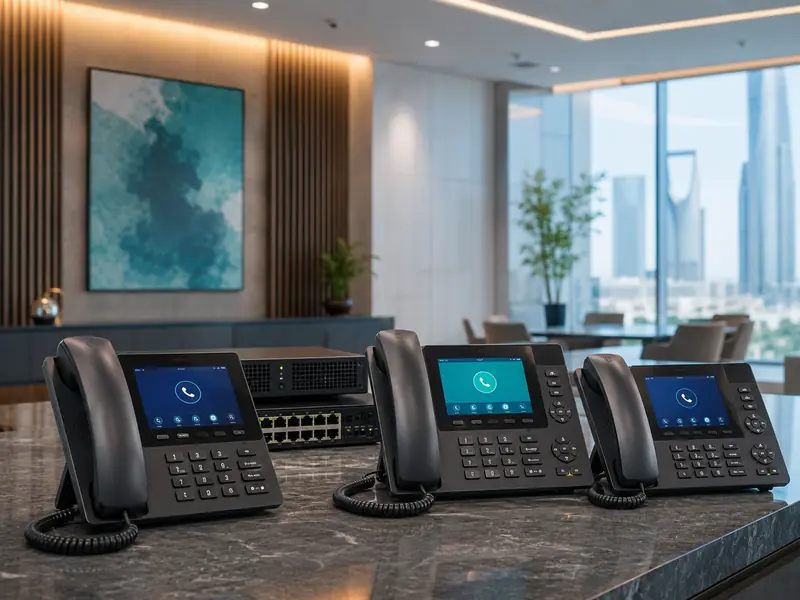
A small office, a multi-department company and several branches do not need the same call flow, so we define real usage before selecting equipment.
Not every company needs every PBX feature. We define the workflow first, then choose the PBX, phones and line integration that fit it.
Each employee or department gets a clear internal number for faster calling and transfers inside the company.
Greets callers and routes them to the right department instead of relying on manual transfers.
We verify the carrier line type first. SIP trunks are different from analog lines that may require FXO ports or a compatible gateway.
Phones are configured with the employee name, extension, permissions and useful keys for daily work.
Calls can ring several users or wait in a queue when required instead of being lost at one extension.
Extensions can communicate between branches after the network, internet and security requirements are reviewed.
Extension count matters, but it is not the only sizing factor. Concurrent calls, line types and required features can change which PBX is appropriate.
Do not choose a PBX only because it supports a high extension count. The right system must handle the actual call load, line types and features the company needs today, with sensible room for growth.
The goal is to hand over a call system that follows the company workflow, not simply a PBX that has been powered on and programmed.
We review users, phone lines, departments, branches and the network.
We define extensions, IVR, ring groups, business hours and routing.
The PBX, phones, external lines and user permissions are configured.
We test internal and external calls, transfer, IVR and agreed fallback routes.
We explain the basic daily functions required by the responsible user.
We work with different IP PBX and IP phone options. Final selection depends on compatibility, capacity and required functions.
Model availability and functions vary by product and project; compatibility and capacity are confirmed before supply and installation.
We size the PBX after reviewing users and extensions, concurrent calls, external line types, departments, branches and required features. Extension count alone is not enough to choose the correct capacity.
An IVR greets callers and routes them to the appropriate department, such as sales, accounts or support, reducing manual transfers and organizing incoming calls.
Often yes after the line type and connection method are verified. SIP trunks differ from analog lines, which may require FXO ports or a compatible gateway.
Yes when the network and connectivity are suitable. The branch connection method is selected based on the sites, security policy and available internet rather than assuming one design for every project.
Internal calls on a local PBX may continue, while internet-dependent services such as SIP trunks can be affected. A backup route can be planned when continuity is required.
Send us the number of users, line types and branches, and we can arrange a survey to define capacity and call flow before choosing hardware.