
Site survey and scope
Review building use, spaces, environmental conditions, hazards, cabling routes and existing equipment before confirming the work scope.
We start with building use, spaces, hazards and cabling routes, then define detection, notification and firefighting scope according to the approved plan and project requirements before installation.
 FIRE ALARM · SAFETY
Every site is different, so building use, layout and hazards come before device selection.
Device types, quantities, locations and firefighting equipment are determined from approved plans, site requirements and the relevant authorities. We do not treat an estimated device count as a final design before project review.
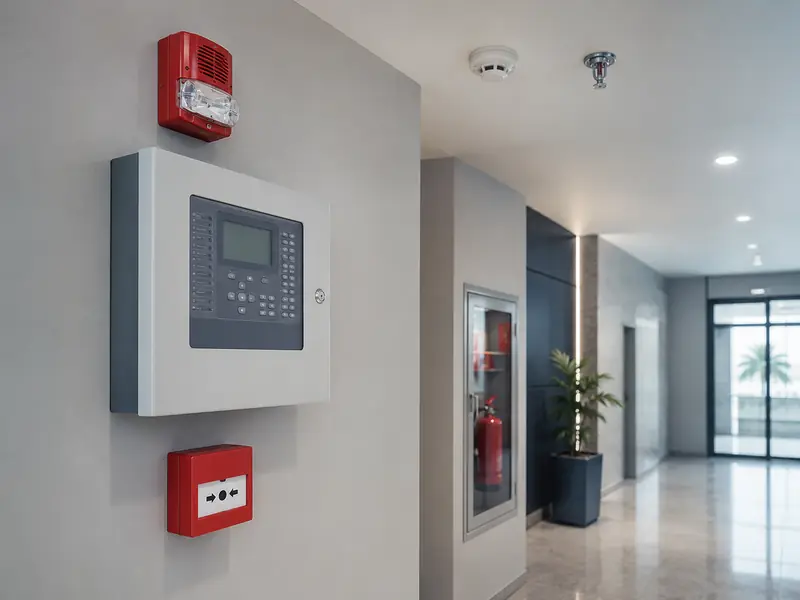
A fire protection solution is more than a panel or a single detector. The design brings together detection, notification, power and required firefighting equipment based on the site type, approved plan and project scope.
Review building use, spaces, environmental conditions, hazards, cabling routes and existing equipment before confirming the work scope.
Select a conventional or addressable panel, capacity and zone or loop structure around the site design and expected expansion.
Select smoke, heat or other suitable detection for the environment, with manual call points positioned according to the system plan.
Install and connect bells, sounders and visual indicators where required as part of the alarm and testing circuit.
Provide extinguishers, hose reels or fixed suppression systems when included in the approved plan, site requirements and project scope.
Configure the panel where required, label zones or points, test alarm and basic fault functions, then explain operation and follow-up.
Building use, size, layout, hazards and approved plans determine the system. Detector count or floor area alone is not enough.
| Site type | Review priority | What we review |
|---|---|---|
| Home or villa | Notification and exit routes | Room layout, kitchens, corridors, heat and electrical sources and the suitable notification method. |
| Shop or office | Occupancy and zoning | Entrances, exits, service rooms, partitions, manual call points and notification devices. |
| Warehouse or workshop | Hazard and environment | Height, dust or heat, material type, storage zones and the detection or suppression required by the project plan. |
| Multi-area facility | Point management and expansion | Zone or loop count, panel capacity, floor-to-floor arrangement, standby power and event identification. |
Steam, dust, heat and ventilation differ between rooms, so detection should match the environment and system design.
Panels, detectors and notification devices have capacity and compatibility limits that should be reviewed first.
Main and standby power are part of system reliability and should be checked during testing and maintenance.
Installed devices are not automatically ready; testing and maintenance can reveal faults, contamination, weak batteries and site changes.
Review site use, spaces, existing equipment and cabling routes.
Specify the panel, detectors, manual call points, notification devices and firefighting equipment required by the project design.
Complete cabling and install devices, panel and equipment at the defined routes and locations.
Set zones or addresses and agreed functions, and identify points where supported.
Test operation, notification and basic fault functions, then explain use and follow-up to the responsible user.
No. A fire alarm system is designed to detect fire-related conditions and initiate notification, while an intrusion alarm focuses on unauthorized entry or movement.
A conventional system typically identifies a zone, while an addressable system can identify an individual device or point more precisely. The choice depends on building size, layout, expansion and maintenance needs.
There is no single detector type suitable for every area. Selection is affected by the environment, ventilation, steam, dust, temperature and expected hazard.
Yes. The system and its components should be inspected and tested periodically in line with manufacturer instructions, the maintenance plan and applicable site requirements.
It may be possible after checking panel capacity, available zones or loops, device compatibility, power, standby batteries and the current design.
Send the site type, layout, available plans and photos of any existing panel or devices, and we will identify what should be surveyed before selecting, expanding or maintaining the system.